How to Inspect a Used VMC Before Buying: A Practical Buyer's Guide
An 8-minute buyer's guide covering paperwork, spindle inspection, ways and ball screws, controller checks, and test cuts. Everything Machine City checks before buying a VMC ourselves.
Anirudh Singla
Managing Director
Reading time: 8 minutes · Published by Machine City · Mohali, Punjab
Buying a used Vertical Machining Center is one of the smartest capital investments a manufacturing shop can make — if you buy the right one. A good used VMC delivers 80% of new-machine performance at 30–40% of the price, and often ships in weeks instead of the 6+ month lead times for new imports. But a bad used VMC becomes an expensive lesson: hidden spindle damage, worn ways, or a controller nobody can service.
At Machine City we have inspected and traded over 5,000 machines across 16 years. This guide walks through everything we check before we buy a machine ourselves, and everything you should check before you buy one from us or anyone else.
Before You Visit: Paperwork Homework
The biggest mistakes buyers make happen before they even see the machine. Get these five documents from the seller before your inspection trip:
1. Name Plate. Confirms year of manufacture (not year of import), and country of origin. A machine "manufactured 2015" but sold to India in 2019 has 4 years of production run somewhere else you need to understand.
2. Fanuc/Siemens/Mitsubishi controller diagnostic report. All modern CNC controllers store hours of operation, alarm history, and axis load records. You can see them on screen of machine.
3. List of consumables and accessories included. Tool holders? Tombstone or fixture plate? Coolant tank? Chip conveyor? Get an exact bill of materials in writing. Machines are often quoted "with everything" but accessories worth ₹2–5 lakh mysteriously stays behind.
If the seller pushes back on providing any of these, be cautious. Legitimate dealers have this ready.
Spindle: Where 60% of a VMC's Value Lives
The spindle is the most expensive component to replace on a VMC. A spindle rebuild on a mid-size VMC can cost ₹3–5 lakh, and a full replacement can approach half the price of a used machine. Check it first, check it thoroughly.
Visual inspection
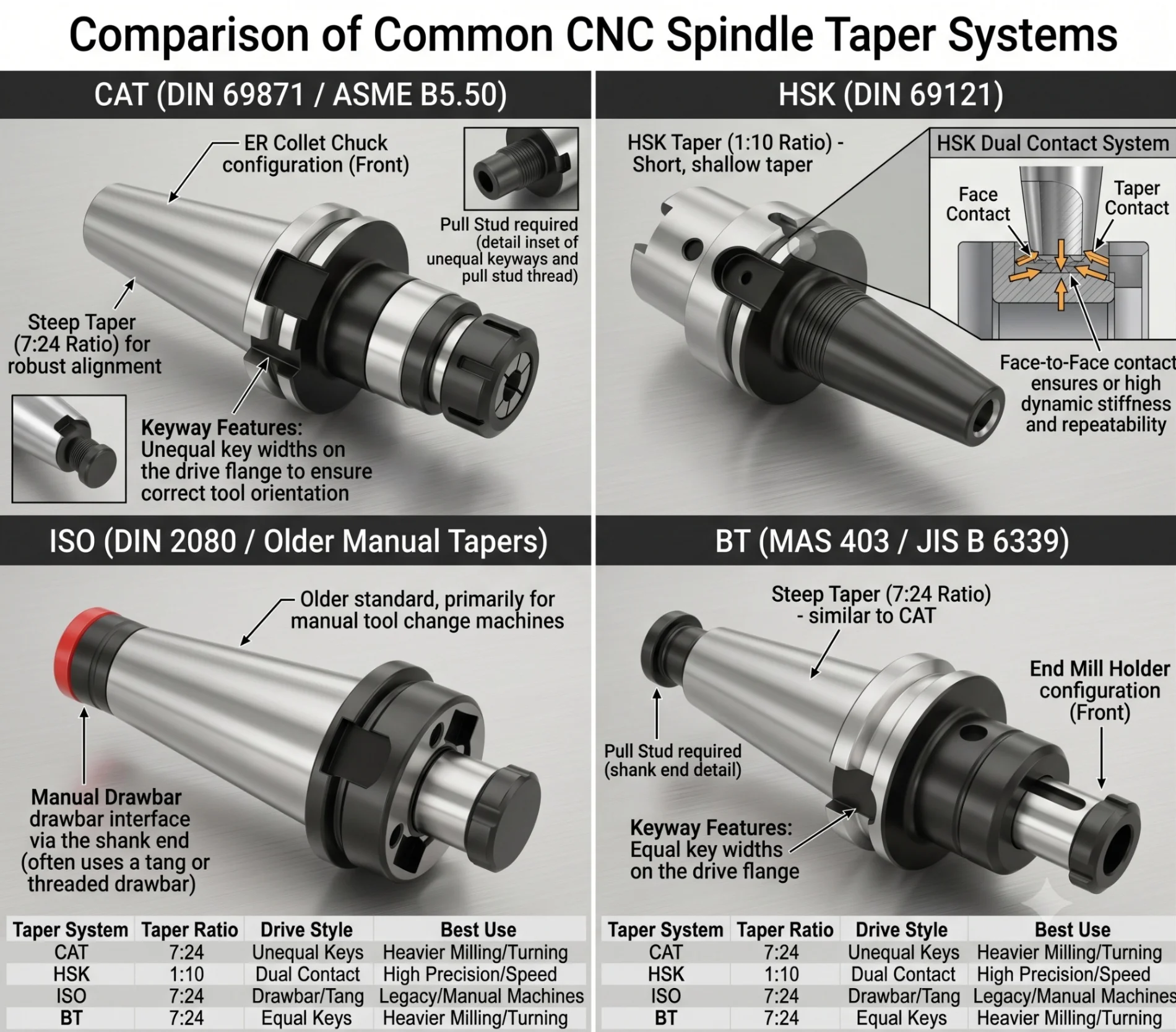
Look inside the taper (BT40, CAT40, BBT40). It should be smooth with no galling, no bluing from heat, no dents. Any pitting or discoloration means a tool holder was slammed in dry or the spindle got too hot at some point.
Check for oil leaks around the spindle nose. Streaks below the nose or coolant in the taper area is a red flag.
Run your fingernail along the pull-stud area. It should be smooth.
Runout test
Ask for a test bar or precision dowel to be mounted in the spindle.
Use a magnetic-base indicator to measure runout at a distance from the spindle nose.
Acceptable: <20-25 microns for a used industrial VMC. A brand-new spindle typically shows <2 microns.
Runout above 30 microns means the spindle bearings are worn.
Thermal test
Run the spindle at 50% of max RPM for 10 minutes.
Feel the spindle housing with your palm — it should be warm, not too hot to touch.
Listen for unusual sounds: grinding, ticking, or whining under load indicates bearing damage.
Watch the load meter — a smooth curve rising to steady state is healthy. Erratic or fluctuating load indicates internal issues.
Full-RPM test
If the seller allows it, run the spindle to max RPM for 30 seconds.
Any vibration, screaming, or grinding sounds means you're looking at a rebuild.
Ways, Ball Screws, and Axis Motion
The linear axes (X, Y, Z) determine how accurately the machine can position — and how long it stays accurate under production.
Way inspection
Visually inspect the way covers. Damaged or missing bellows means chip and coolant have been getting to the ways for a long time.
Slide the way covers back manually (with the machine off). Look at the way surface. It should be smooth, with visible flaking pattern from original scraping. Deep scoring, rust, or worn-through hardened surfaces shows that is used for long hours.
Check for uneven wear — often the middle of the travel wears faster because that's where most work happens. If X travel is 850mm and the middle 400mm shows deep wear, positioning accuracy in that zone will be compromised.
Ball screw check
With the machine on and safety enabled, jog each axis slowly through its full travel.
Listen for grinding, clicking, or grating sounds — these indicate ball nut damage.
Watch the way covers — they should move smoothly, without jerking.
Check backlash by jogging a small distance one direction, then reversing. Modern VMCs should have <10 microns backlash on all axes but it can be rendered in controller.
Positioning accuracy test
If the seller has a laser interferometer or granite reference, ask for a positioning report.
Otherwise, indicate on a test cut: mill a Diameter of 100mm round pocket, then measure with a caliper or micrometer. Real-world accuracy tells you what production will look like.
Controller and Electronics
The CNC controller is the machine's brain. A dead controller is often unrepairable on old machines because parts are no longer manufactured.
Fanuc controllers — Fanuc supports back to the 0i-Mate but 20+ year old series can be hard to service. 30i/31i/32i are current and future-proof.
Old Siemens, Mitsubishi, Heidenhain controllers are not supported.
What to check
Power on the machine and let it boot completely. Watch for alarm codes, boot delays, or error messages.
Ask the seller to demonstrate the operator panel — every button, every axis jog, MDI mode, automatic mode, tool change command.
Check the display — dead pixels, screen flicker, or dim areas indicate CRT/LCD failing. Replacement panels for old controllers cost ₹1.5–3 lakh.
Look at the battery status. Fanuc controllers need lithium batteries changed every few years — an alarmed battery may have caused parameter loss.
Ask when the ladder logic was last backed up. If nobody has a backup, one accidental parameter reset can brick the machine.
Tool Changer (ATC)
The automatic tool changer is the second most complex mechanical assembly after the spindle. Cycle it through every pocket at least twice.
Watch for hesitation, misalignment, or grinding during tool change.
Every tool pocket should present smoothly. If any pocket has a rough motion, that particular pocket may need adjustment or the umbrella carousel may be misaligned.
Tool changer sequence times: 3–5 seconds is normal. Slower than that indicates worn pneumatics or sequence delays.
Umbrella-type changers (small VMCs) are simple. Chain-type changers (larger VMCs) have hundreds of moving parts — inspect carefully.
Coolant System, Chip Management, and Hydraulics
The support systems reveal a lot about how the machine was maintained.
Open the coolant tank. Look at the fluid: is it fresh or does it smell rancid? A neglected coolant system means neglected maintenance overall.
Inspect the chip conveyor. Bent flights, torn wipers, or seized rollers cost ₹40,000–₹1 lakh to repair.
Look at way lube tank and hydraulic reservoir levels. If they're low or empty, the machine was recently drained for transport — not always a problem, but confirms it may have been sitting.
Turn on coolant flow. Weak pressure or air in the lines indicates pump or seal issues.
Under the Machine
Get down and look underneath. This is where sellers hide issues.
Coolant puddles, oil drips, hydraulic weeps — all indicate seal failures.
Rust on the base casting is a red flag — it means the machine sat in a humid environment or ran without proper drip pans.
Check the leveling pads. Cracked or missing pads mean the machine was moved multiple times and re-leveled poorly.
Run a Real Test Cut
Nothing beats a live test cut. Bring your own test piece if possible — 200 x 200mm mild steel bar is a good universal test material.
Recommended test program:
Face the top with a 63mm face mill at 800 RPM, 0.15mm feed per tooth, 2mm depth of cut. Listen for chatter, watch surface finish.
Mill a 50mm × 50mm × 15mm deep pocket using pocketing cycle. Measure the finished dimensions.
Drill and tap M8 × 1.25 through the pocket. Rigid tapping tells you the spindle synchronization is working.
Measure everything with a caliper and depth gauge. Real accuracy under load is what matters, not what the spec sheet says.
If the seller refuses a test cut, walk away. Every legitimate dealer will let you cut on their machine.
Common Pitfalls Buyers Fall Into
"But it looks clean." A repaint costs ₹15,000. Some sellers repaint old machines to make them look 2010 vintage when they're actually 1998. Always cross-reference year with controller software version, spindle serial number, and import documents.
"The seller says the spindle was just rebuilt." Ask for the rebuild invoice with dates, hours-since-rebuild, and the rebuilder's contact. A verbal claim means nothing.
"Low hours" claim. Only Fanuc/Siemens/Mitsubishi controller prove actual hours on screen.
Buying without a video walkaround first. Never travel 500 km to inspect a machine you haven't seen a proper video of. Ask the seller for a 5-minute walkaround showing all four sides, the ATC in operation, the spindle running, and a live test cut. This saves everyone's time.
The 10-Question Final Checklist
Before you make an offer, answer YES to all of these:
Have I verified year of manufacture ?
Have I measured spindle runout <20 microns?
Have I confirmed the controller boots without errors?
Have I cycled the tool changer through pockets?
Have I inspected all ways for scoring or excessive wear?
Have I looked underneath for oil/coolant leaks?
Have I run a test cut and measured the results?
Do I have a written list of everything included?
Have I confirmed spare parts and controller service is available?
Have I negotiated a return period or performance guarantee?
If any answer is NO, either resolve it or discount your offer accordingly.
How Machine City Approaches This
Every machine on our floor at Plot 159, JLPL Sector 82, Mohali goes through this same inspection. Before we buy it. Before we import it. Before we sell it to you.
We import primarily from Canada, USA, and Singapore because those markets have strong maintenance cultures — machines there tend to be well-documented and well-cared-for. Every machine gets a video walkaround, a diagnostic printout where available, and a written condition report.
If you're evaluating a used VMC — whether from us or another dealer — we're happy to answer questions. WhatsApp us at +91 91154 38766 or browse our current stock at machinecity.in.
Buying used doesn't have to be risky. It just has to be careful.
Anirudh Singla· Managing Director
Managing Director at Machine City. 16 years of experience in used CNC and industrial machinery trading.