New vs Used CNC Machines: Real Total Cost of Ownership
Sticker price is only part of the story. A practical look at how new and used CNC machines really compare on total cost of ownership — lead time, depreciation, downtime risk, resale, and where SMEs get the best long-term value.
Anirudh Singla
Managing Director
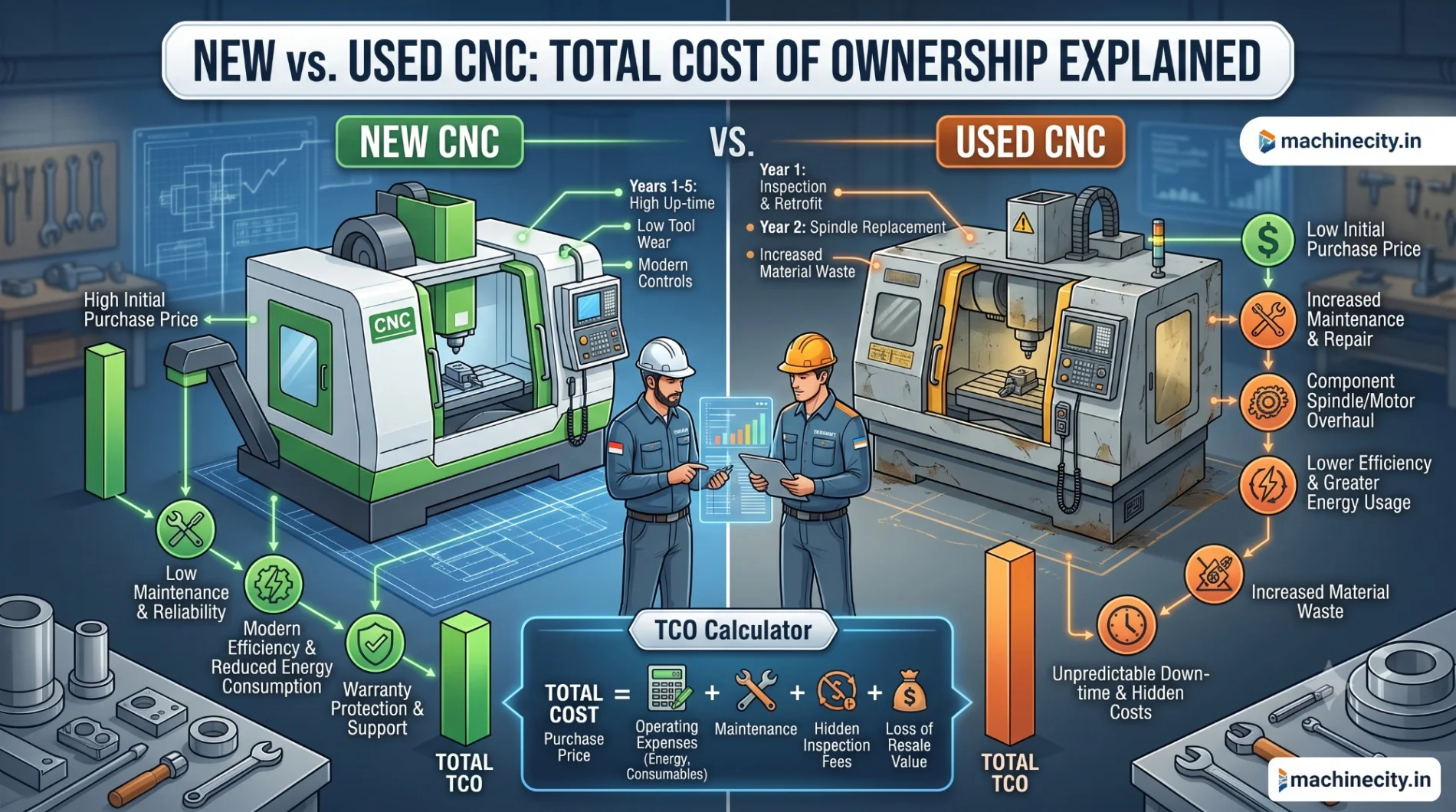
When most buyers weigh a new CNC machine against a used one, the conversation starts and ends with the invoice. That is the wrong frame. A CNC machine is a multi-year production asset, and the real question is total cost of ownership — what the machine actually costs you over its working life on your shop floor, per part produced. Once you look at it that way, the sticker becomes just one input among many, and used machinery from a reputable source often tells a very different story than it does on paper.
What total cost of ownership actually includes
TCO for a CNC machine covers acquisition cost, lead time, financing charges, installation and commissioning, tooling and fixturing, consumables, spares, service contracts, downtime risk, operator training, energy consumption, and eventual resale value. Two machines with very similar quoted prices can produce very different TCO outcomes once you stretch the timeline to five, seven, or ten years. This is the lens every production manager and shop owner should use before signing.
Cost factors for new machines
A new machine gives you the newest control platform, the latest spindle and drive technology, a full manufacturer warranty, and a clean service history. That has real value, especially for tight-tolerance work or when you are chasing certifications that reward documented, current equipment.
The trade-offs are equally real. Lead times from OEMs can run into months, sometimes longer for specific configurations, which means capital is committed well before the machine earns a rupee. Financing costs accumulate against an asset that is not yet cutting chips. Depreciation is steepest in the first two to three years, and you absorb that curve whether the machine is running two shifts or sitting idle. And upfront capital lock-in reduces your flexibility to invest elsewhere in the shop: a second spindle, better tooling, an inspection cell.
Cost factors for used machines
A used CNC machine flips several of those variables. Availability is immediate. An inspected machine on the floor of a dealer can be at your facility in weeks, not quarters, which shortens the gap between spending money and making money. Capital outlay is lower, which frees cash for tooling, fixturing, or a parallel investment in adjacent capacity. Used machinery from a reputable source often tells a very different story than it does on paper.
The trade-offs to manage are different, not smaller. You need proper inspection: spindle condition, ball-screw and guideway wear, control health, backlash measurement, geometric alignment. You need documentation: service records, run hours, and any known repairs. You may need selective refurbishment: retrofit of a control, resurfacing of ways, replacement of a spindle cartridge. You need to budget for freight, rigging, foundation work, and installation. And you need to confirm tooling and fixture compatibility so you are not rebuilding your entire work-holding library.
Bought from an unknown source, those unknowns become risk. Bought from an inspected, documented source, they become a defined, priced scope of work.
Depreciation and resale
New machines take the sharpest depreciation hit in the early years. A used machine bought at a reasonable point on that curve, from a seller who has verified condition and provided documentation, tends to hold its value proportionally better. If you decide two or three years later that you need a different capability, your position on resale is often stronger than it would be on a newer machine that still has significant depreciation to shed. But it all depends upon how you manage your machine. Maintenance happens routinely, Proper conditions of machining are met, regular lubrication is happening, and repair is done acc. to standard procedures if any happens. If these are not done, used machinery price also depreciates.
Downtime is the hidden number
Every hour a CNC sits idle is unmade parts, missed deliveries, and idle operators. This is where sourcing quality dominates every other TCO input. An unvetted used machine can burn its entire acquisition savings, and more, in a single extended breakdown while you wait on obsolete parts. An inspected machine with a known history, documented spares, and a seller who stands behind the transaction gives you predictable uptime. Downtime risk is not eliminated by buying new; it is managed by buying from a source that has actually looked at the machine.
A framework for SMEs
Before you decide new or used, work through these questions honestly.
What tolerance and surface finish does the part actually require?
How quickly do you need the capacity online?
What is the opportunity cost of the capital difference if deployed elsewhere in the shop?
What is your tolerance for downtime, and what support will you have behind the machine?
Does the machine's documented condition match your production plan?
For most Indian SMEs running job-shop, tier-2, or growing tier-1 work, a well-inspected used CNC machine wins on TCO, provided the seller has done the diligence and can prove it.
Where Machine City fits
Machine City's inventory of used CNC machines is inspected, documented, and priced to reflect real condition, not guesswork. That converts the biggest risk of buying used, uncertainty, into a defined scope you can plan around. If you are weighing a specific requirement, send an enquiry through the site or reach out via WhatsApp and we will walk through fitment, condition, and logistics for your shop with no price pressure.
Anirudh Singla· Managing Director
Managing Director at Machine City. 16 years of experience in used CNC and industrial machinery trading.