Why Buy Machinery Imported from Canada, USA & Singapore — Our Sourcing Process
Where a used machine comes from is the strongest single predictor of how much life it has left. Here's why Machine City sources from Canada, USA and Singapore — and how each machine is vetted before it reaches your shop floor.
Anirudh Singla
Managing Director
When you're spending lakhs on a used CNC or industrial machine, the seller's story is only half the picture. The other half is where the machine actually came from — the shop floor it ran on, the operator culture that maintained it, and the paperwork that travelled with it. Country of origin isn't a marketing detail. It's the single strongest predictor of how many productive years a used machine has left in it.
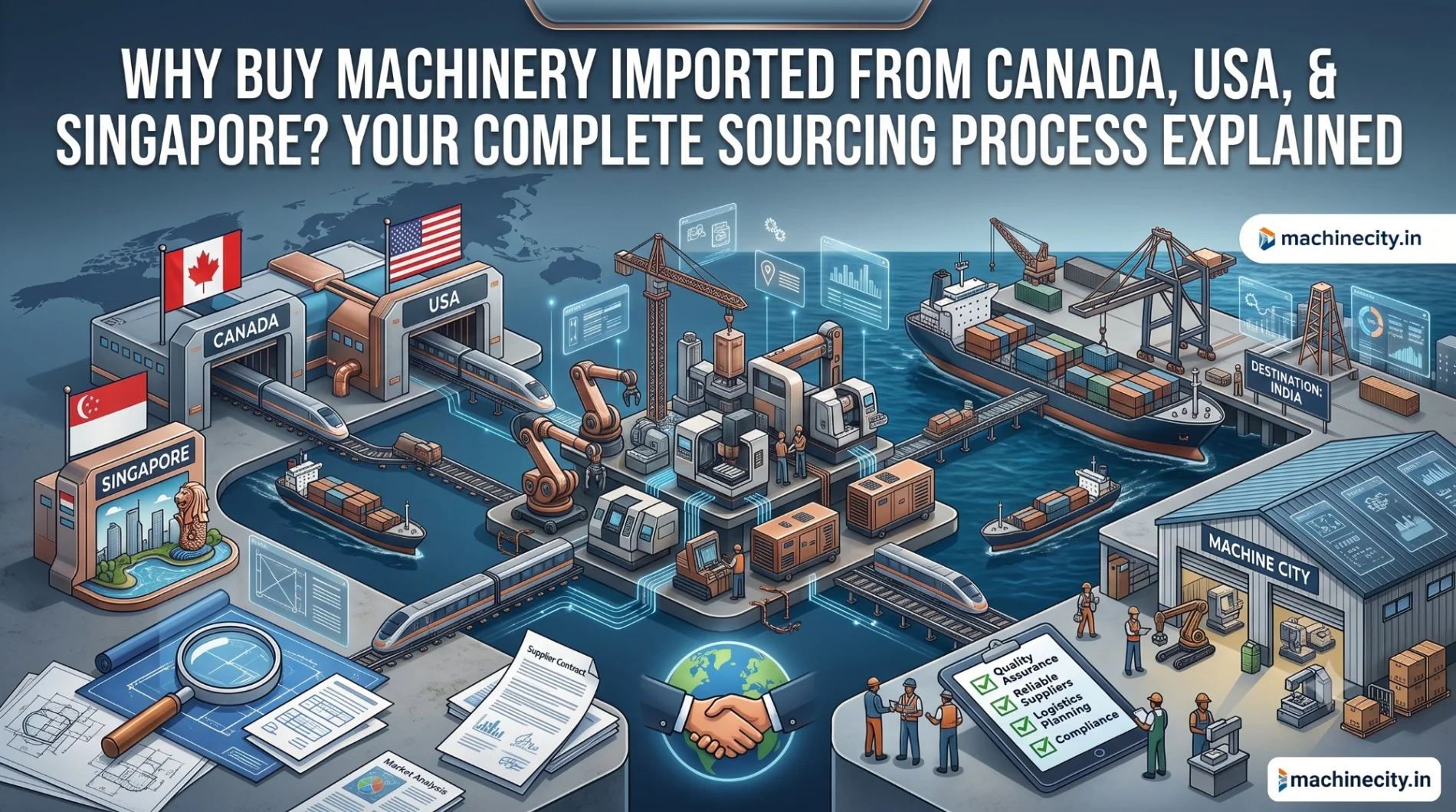
At Machine City, almost everything we bring in is imported from Canada, the USA, or Singapore. That isn't accidental. Here's why we've built our sourcing pipeline around these three markets, and how a machine actually gets from a shop floor there to your factory here.
Why country of origin matters
Two machines with the same make, model, and year can be in wildly different condition. A VMC that ran three shifts a day in a humid, dusty environment with a "run it till it dies" maintenance culture is not the same machine as one that ran a single shift on climate-controlled premises with a logged service schedule. On paper they're identical. In practice, one has years left in it and the other is a project.
Used machinery from certain markets is systematically better cared for. That's what makes origin the first filter, before make, model, or hours.
What makes Canada, USA & Singapore different
Stricter operating and safety standards. Shops in these markets operate under regulatory regimes (OSHA, Canadian provincial equivalents, Singapore's WSH framework) that require documented maintenance, guarding, and periodic inspection. Machines are looked after because compliance depends on it.
Better duty cycles. A lot of North American and Singaporean shops run one or two shifts rather than continuous production. Spindles, Guideways, and ball screws simply see less wear per calendar year than equipment run flat-out in higher-utilisation markets.
Climate. Controlled shop environments and lower ambient humidity mean less corrosion on ways, tables, and electronic cabinets. Machines from Singapore's air-conditioned precision-engineering shops arrive with almost no oxidation.
Documented service history. In these markets it's normal for a machine to come with service logs, calibration records, and even the original operator manuals. That paperwork is worth real money at resale — it tells you exactly what has and hasn't been done.
Late-model tech at reasonable ages. North American and Singaporean shops upgrade equipment on shorter cycles, which means the used market carries relatively modern controls (Fanuc, Siemens, Mitsubishi) with plenty of life left.
How Machine City actually sources a machine
Our process has four stages, and we don't shortcut any of them.
1. Sourcing network at origin. Over years of imports, we've built direct relationships with dealers, auction houses, and end-user shops across Canada, the USA, and Singapore. That network is what lets us see machines before they hit open listings, and it's what lets us walk away from ones that don't check out.
2. Import logistics and customs. We handle the full chain — freight booking, marine insurance, HS classification, customs clearance, and inland transport to Mohali. Because we import continuously, we know the paperwork inside out. That's where a lot of one-off buyers get burned: duty structure, EPCG interactions, and clearance timelines are not casual work.
3. Re-inspection and refurbishing on arrival. Nothing goes to a buyer straight off the container. Every machine is re-tested on our floor, cleaned, checked mechanically and electrically, and refurbished where needed — belts, filters, fluids, worn wipers, minor electrical work. If a machine has an issue that showed up in transit, you don't inherit it.
Why credentials matter for an import operation
Anyone can call themselves an importer. Very few can back it up. Machine City holds:
MIA (Mohali Industrial Association) membership — recognition inside the Industrial industry.
MSME registration — formal Indian small-enterprise standing.
IEC (Import Export Code) — the mandatory registration to legally import commercial goods into India.
Those three together mean the paperwork on your machine is legitimate end to end, and that you're buying from a registered, accountable business — not from a broker fronting for someone else's shipment.
Buying through Machine City vs an unverified broker
An unverified broker typically shows you photos, quotes a number, and disappears once the payment is made. If something goes wrong at customs, in transit, or on arrival, it's your problem. There's no re-inspection, no refurbishing, and often no traceable paperwork on the machine's origin.
Buying through Machine City means the machine has been seen by us at origin, cleared by us through customs, and re-tested by us before it reaches you. If there's an issue, there's a real business — three directors, a registered address in Mohali, and a paper trail — standing behind it.
If you're evaluating a specific machine or want us to source something for a particular application, reach out via WhatsApp or send an enquiry through the site. No pricing pressure — we'll talk through what's available, what's realistic for your requirement, and where it's coming from.
Anirudh Singla· Managing Director
Managing Director at Machine City. 16 years of experience in used CNC and industrial machinery trading.