How to Inspect a Used Lathe Before Buying: A Practical Buyer's Guide
A practical buyer's guide to used conventional lathes — the specs that matter, a hands-on inspection checklist, the questions to ask a seller, and how Machine City helps you buy proven iron with confidence.
Anirudh Singla
Managing Director
Reading time: 6 minutes · Published by Machine City · Mohali, Punjab
A conventional center lathe is the backbone of almost every machine shop — it turns, faces, bores, threads, and knurls, and a well-built manual lathe from a reputable maker can stay productive for decades. That longevity is exactly why the used market makes sense: a machine that has been maintained properly still holds tight tolerances long after it was first commissioned, and buying used lets you put a heavier, more rigid lathe on your floor without the wait or the outlay of a comparable new one.
At Machine City we have inspected and traded over 5,000 machines across 16+ years. This guide walks through what to check before you commit, the questions worth asking, and how buying through us removes the usual risk.
Key Specifications to Check
Start by matching the machine's working envelope to the parts you actually turn. The specifications that matter most on a center lathe are:
Swing over bed — the largest diameter that clears the bed. Check swing over the cross-slide too, since that is the real limit for most work.
Distance between centers — the longest shaft or bar the lathe holds between headstock and tailstock. Buy for your longest job, not your average one.
Spindle bore — the through-hole diameter in the spindle. Critical if you feed bar stock through the headstock; measure it against your largest bar.
Spindle speed range — the spread of RPMs and the number of steps. A wide range with sensible low speeds matters for large diameters and threading.
Chuck size and mounting — confirm the chuck diameter, jaw type, and spindle nose (camlock or threaded) so tooling and future chucks fit.
Tailstock — confirm it is present, complete, and that the quill, taper, and clamping are in good order.
Condition and Inspection Checklist
Specifications tell you what the machine was designed to do; condition tells you what it will still do. Focus on:
Bed way wear — the most important wear point. Look for ridging, scoring, or a visible step near the headstock where most cutting happens. Uneven ways translate directly into taper and poor finish.
Spindle runout — mount a dial indicator and check runout at the spindle nose and in the chuck. Excessive runout points to worn bearings and shows up as chatter and out-of-round parts.
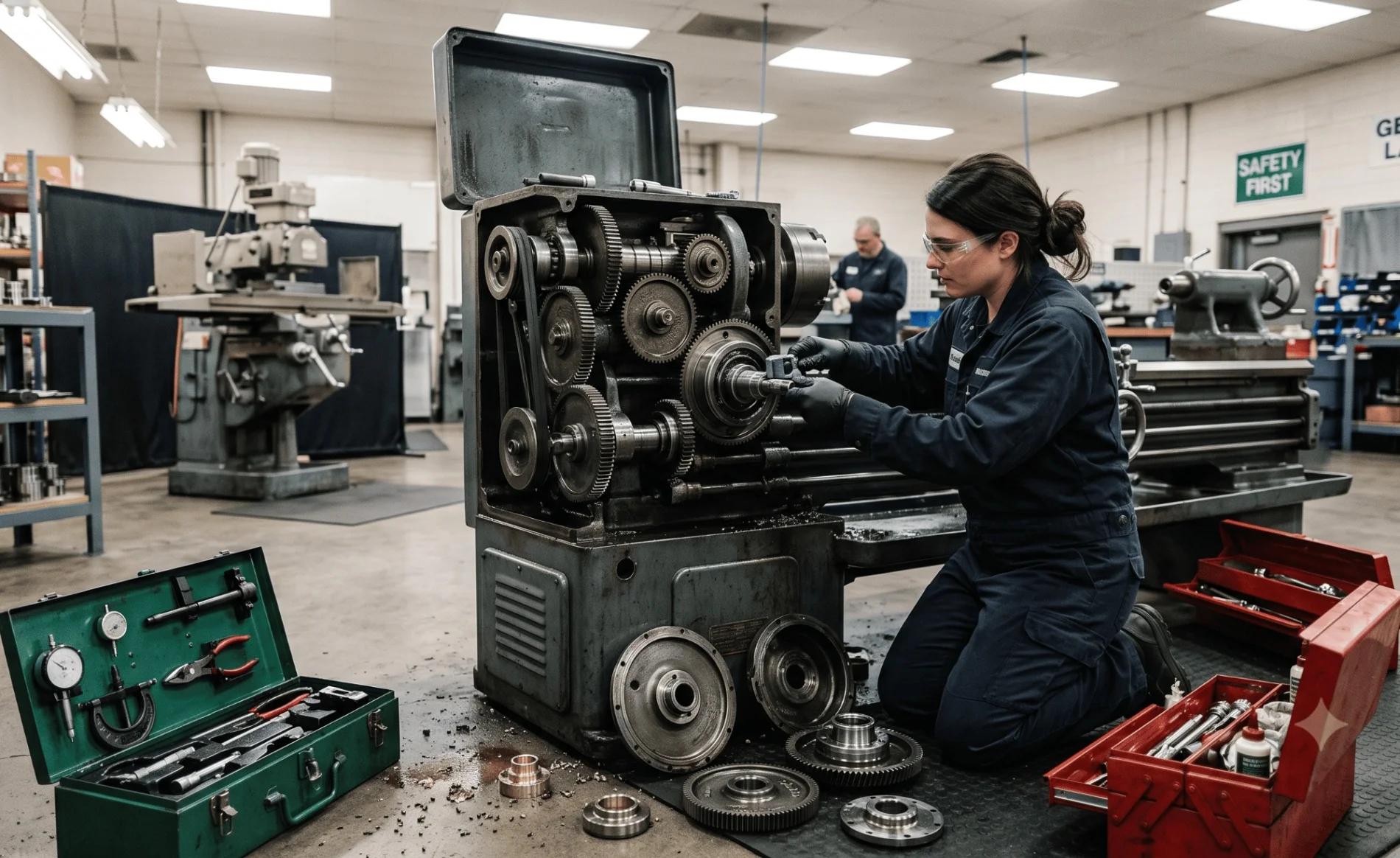
Headstock gears — run the machine through its speed range and listen. Grinding, whining, or slipping under load signals worn gears or bearings that are expensive to put right.
Tailstock alignment — turn a test bar between centers and measure both ends. A consistent diameter confirms alignment; a taper flags a problem.
Hours, age, and maintenance — ask how the machine was used. A lathe from a toolroom or training environment is usually gentler than one that ran production shifts for years.
Questions to Ask the Seller
A few direct questions reveal a lot. Ask where the machine came from and what it was used for, whether it has been under regular maintenance, and why it is being sold. Ask if it powers up and runs under load, whether the original chuck, steady rest, follow rest, and change gears are included, and what the electrical supply requirements are. Finally, ask whether the seller can share recent photos or a video of the lathe running, and whether the machine has been independently inspected.
Why Buy Your Used Lathe Through Machine City
With more than sixteen years in the used-machinery trade and thousands of machines handled, we treat every lathe as something we would be willing to run ourselves. Machines are inspected before they reach you, so you are not buying a description — you are buying a checked machine. We regularly source and import quality conventional lathes from Canada, the USA, and Singapore, which means access to well-maintained iron that rarely appears on the local market.
Enquiry is simple and pressure-free. Browse the lathes in our inventory, and when something fits, send an enquiry or reach out via WhatsApp. We will talk you through the machine's condition, specifications, and availability, and help you decide whether it is the right fit for your shop — no obligation, no rush.
Anirudh Singla· Managing Director
Managing Director at Machine City. 16 years of experience in used CNC and industrial machinery trading.