How to Read a Used Machine Listing — Which Specs Actually Matter
Used machine listings are full of numbers, but only a handful actually predict whether a machine will fit your shop. A practical guide to the specs that matter, the ones buyers over-index on, the red flags in a weak listing, and how to cross-reference specs against your own parts.
Anirudh Singla
Managing Director
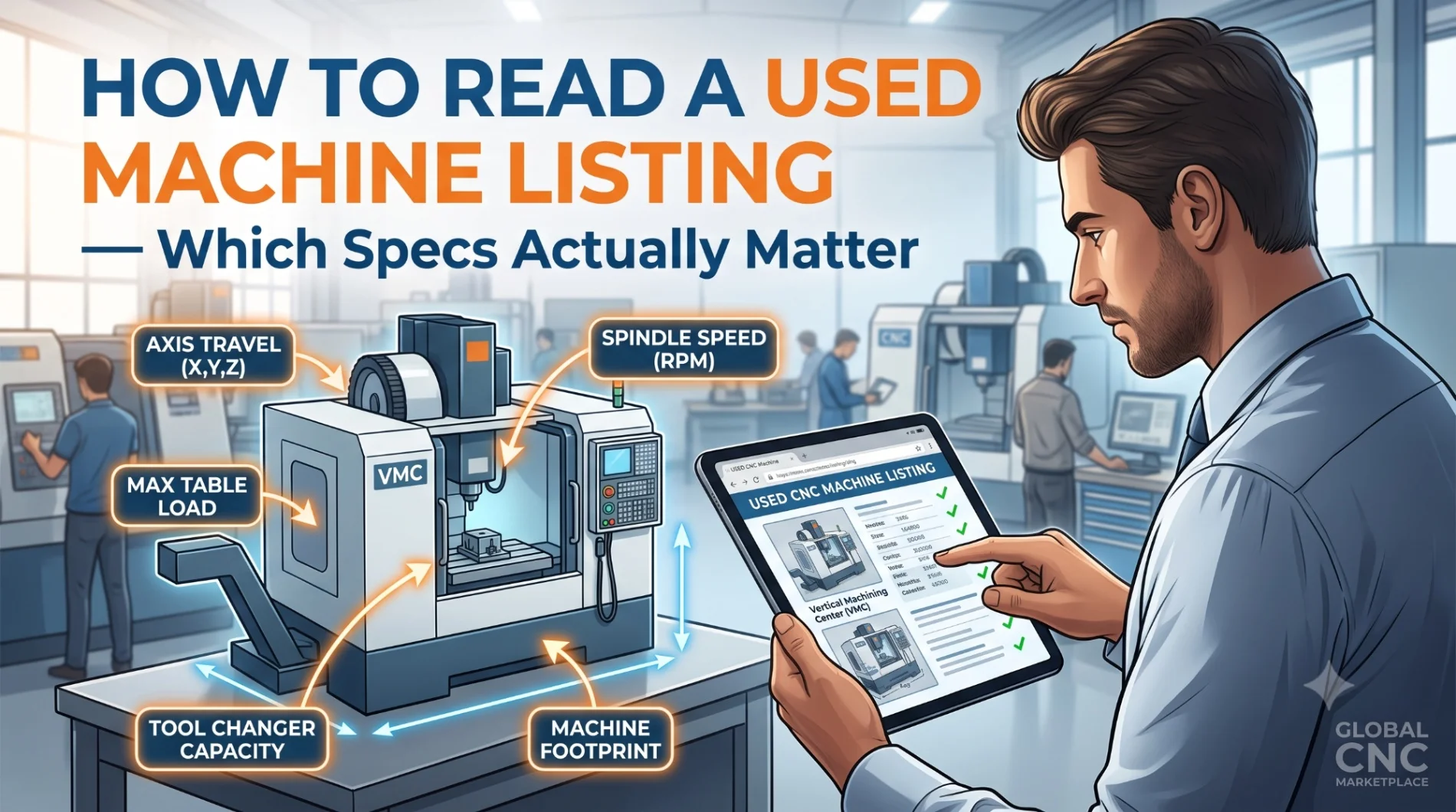
Open any used machine listing and you're looking at a wall of numbers. Travels, RPM, taper, table size, controller model, year, kW ratings, tool positions. All of it is technically true. Very little of it tells you whether the machine will earn its keep on your shop floor.
Experienced buyers don't read listings top to bottom. They check four or five fields, decide whether the machine is even in the conversation, and only then dig into the rest. Here's how to do the same.
The specs that decide fit
Across almost every machine type, the same short list does the heavy lifting:
Axis travel (X / Y / Z). This is the first filter, and it's unforgiving. If your largest part plus fixturing and tool clearance exceeds the travel, no other spec matters. Check Z travel especially — buyers routinely confirm X and Y, then discover the Z stroke won't clear a tall fixture. On a turning machine, the equivalent is max turning diameter and max turning length, plus the through-spindle bore if you run bar work.
Spindle power and torque. Power at the low end of the RPM range is what actually removes metal from steel and cast iron. A machine can list an impressive peak speed and still stall in a heavy roughing cut. On harder material or deep cuts, look at kW and the taper (BT40 vs BT50 tells you a lot at a glance) before you look at RPM.
Control system and brand. The controller determines who can run the machine, whether your post-processor works, and — critically on a used machine — how easy it is to source a drive, encoder or board five years from now. Fanuc controls of the 0i / 18 / 21i generation remain very well supported in India. An unfamiliar or obsolete control isn't a dealbreaker, but it's a real cost to factor in.
Year of manufacture. Useful mainly as context for everything else — spare parts availability, control generation, rigidity standards of that era. A well-maintained machine from the early 2000s under light load often beats a newer machine run three shifts on abrasive work.
Running hours. Hours matter more than year. Ask for both spindle hours and power-on hours where available; the ratio tells you how hard the machine actually worked versus how long it sat idle.
Tool changer capacity. Directly determines whether you can run a full part in one setup. If your typical job needs fourteen tools and the magazine holds twelve, you've bought yourself a second operation on every part.
Condition and state. On our listings you'll see whether a machine is currently with us or still In Transit, and whether it's a third-party unit. This changes your inspection timeline and your planning, so read it before you build a delivery schedule around it.
Specs people over-index on
Top-end spindle RPM. It's the number everyone quotes and the one that matters least for most Indian job shops. A 12,000 RPM spindle is a genuine advantage for aluminium, thin-wall work and small-diameter tooling. If you're roughing EN-series steel or cast iron all day, you'll never see the top third of that range — and you'll have paid for a spindle bearing set that costs more to replace.
Rapid traverse rates. Real on high-mix, short-cycle work with lots of air moves. Almost irrelevant when your cycle is dominated by cutting time on a large batch.
Headline positioning accuracy. Manufacturer figures come from a new machine in a temperature-controlled room. On a used machine, backlash, ballscrew wear and a recent geometry check tell you far more than the original spec sheet ever will.
Cross-reference against your own work
Before you shortlist anything, write down four things: your largest part envelope, your typical material and depth of cut, your usual batch size, and the number of tools a representative job needs. Then read listings against that list rather than against each other.
Large parts, low volume → travel, table load capacity, rigidity. Small parts, high volume → tool changer speed, rapids, spindle acceleration. Hard material → torque, taper, machine mass. Family-of-parts work → setup flexibility and tool capacity.
Red flags versus a well-documented listing
Be cautious of a listing with no year and no hours, brochure photos instead of the actual machine, spec fields left blank or filled with vague ranges, and — the big one — no clear photo of the control panel and spindle nose. Those two photos tell an experienced eye more than a page of specs.
A well-documented listing shows the actual unit, states its year and condition plainly, names the exact controller variant, and gives travels and key capacities in structured form so you can compare like with like.
How Machine City structures its listings
Every machine on Machine City carries a spec card with the fields that matter first — category and subcategory, year, brand and model, the exact controller, and the travels or key dimensions relevant to that machine type. Condition and current state are shown as badges up front, so you know whether a machine is with us or still in transit before you invest time in it. Category filters let you compare within a class rather than scrolling through everything. Photos are of the actual machine, including the controller and spindle.
If a spec you need isn't on the card, ask. Reach out over WhatsApp or send an enquiry from the listing page, and tell us what you're making. Our team includes engineers who've inspected these machines in person — you'll get a straight answer on whether it fits your shop, not a sales pitch.
Anirudh Singla· Managing Director
Managing Director at Machine City. 16 years of experience in used CNC and industrial machinery trading.