Spindle Taper Types Explained: BT vs CAT vs ISO vs HSK
BT, CAT, ISO (SK) and HSK spindle tapers explained in plain terms: how they differ, where each is used, and why taper type matters for tooling compatibility when buying a used machining center.
Anirudh Singla
Managing Director
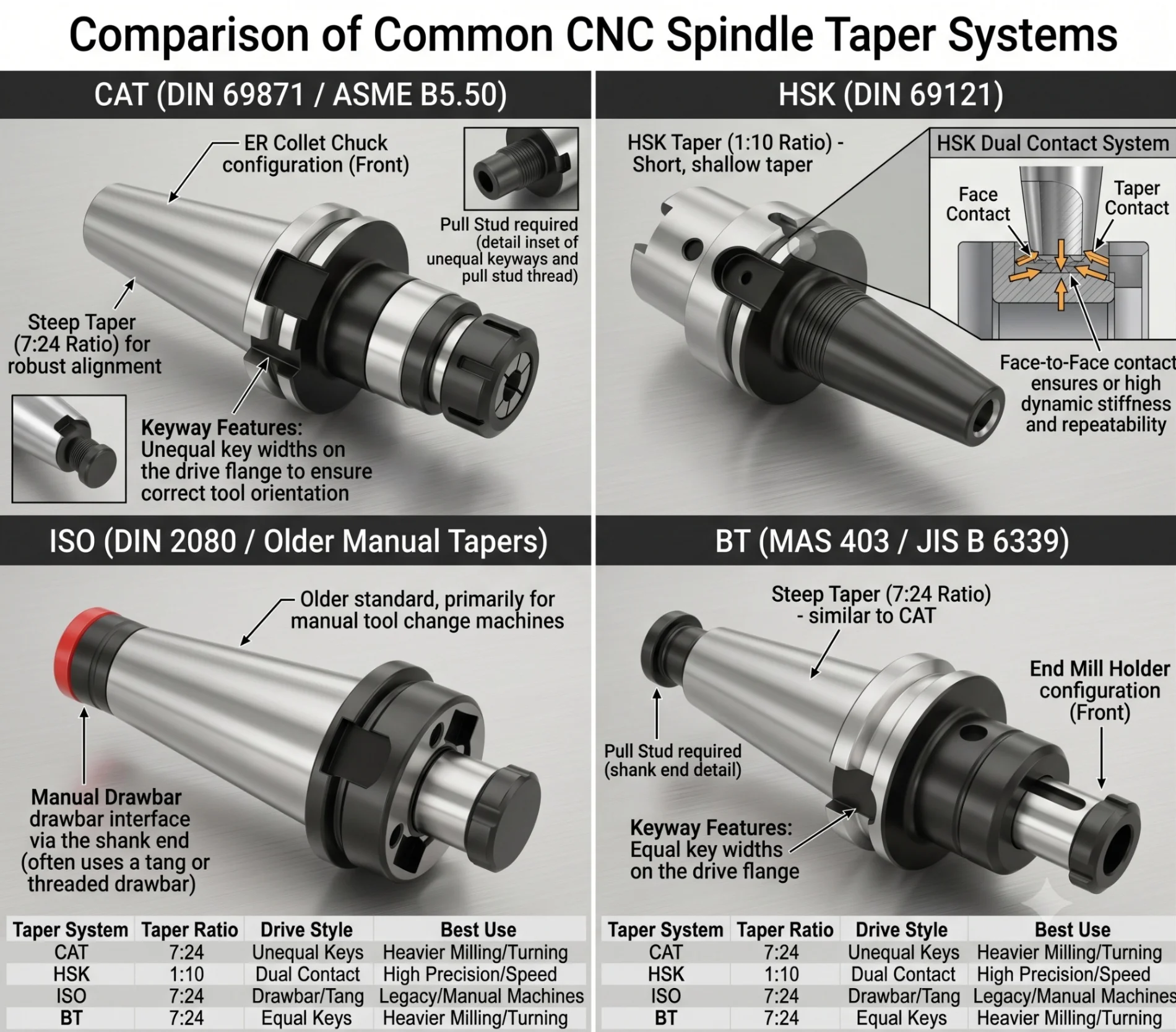
When shop owners look at a used VMC and HMC, the conversation usually starts with table size, travels, spindle speed and control make. Spindle taper type often comes up much later, or not at all. That's a mistake. The taper decides which tool holders fit the machine, how rigid the tool connection is, how fast you can safely run, and how much you'll spend on tooling before the first job comes off the machine.
This guide covers the four tapers you'll see most often on used machining centers (BT, CAT, ISO and HSK) in plain terms, so you know what to check before you commit.
What Is a Spindle Taper?
The spindle taper is the conical seat inside the machine spindle that locates and holds the tool holder. A drawbar inside the spindle pulls the holder in, usually by gripping a retention knob (also called a pull stud) screwed into the back of the holder. The taper's shape, size and clamping method decide how accurately the tool runs and how well it holds up under cutting loads and high RPM.
BT Taper: The Asian-Market Standard
Origin: BT started as a Japanese standard (JIS B 6339, often called MAS-BT) and is now covered internationally under ISO 7388.
Design: BT uses a steep 7/24 taper, meaning the diameter changes by 7 units over a length of 24. The holder seats on the taper only; the flange face does not touch the spindle face on a standard BT holder. Retention knobs use metric threads.
Common sizes:
BT30: smaller, high-speed machines, drill-tap centers and light milling
BT40: the workhorse size, found on most general-purpose vertical machining centers
BT50: heavy-duty machines built for deep cuts and large cutters
Where you'll see it: Almost every machine built by Japanese, Taiwanese, Korean and Chinese manufacturers comes with BT as standard. Since a large share of the used machining centers available in India come from these markets, BT40 is by far the most common taper you'll find on the Indian used-machine market. That also means BT holders, pull studs and collets are easy to source locally.
CAT (CV) Taper: The American Standard
Origin: CAT, also called CV (V-flange), is an American standard defined under ANSI/ASME B5.50. The name comes from Caterpillar, which helped popularise it.
How it differs from BT: Here's where buyers get caught out. CAT and BT use the same 7/24 taper angle, so a CAT40 and a BT40 holder look almost identical at a glance. But they are not interchangeable:
The flange shape and thickness are different
The gauge line and distance from flange to taper differ
CAT retention knobs use imperial (inch) threads; BT uses metric
Drive slot and orientation notch positions differ
Putting the wrong holder in a spindle can lead to poor clamping, runout or damage to the spindle and tool changer.
Where you'll see it: CAT40 and CAT50 are standard on machines built for the North American market, including Haas, Fadal and many older American machines. If you're buying a machine imported from the US, expect CAT unless the listing says otherwise.
ISO (SK / DIN 69871) Taper: The European Standard
Origin: In the trade, "ISO taper" usually means the European steep taper defined by the German standard DIN 69871, often called SK (from the German Steilkegel, "steep taper"). It is now covered internationally under ISO 7388-1.
Design: Like BT and CAT, it uses the 7/24 taper, so an SK40 holder fits the same basic spindle bore size as BT40 and CAT40. The differences are in the flange: SK holders have a different flange profile, a groove shape suited to European tool changers, and metric retention knobs of their own design. Many SK holders also have a coolant-through option built into the flange. As with CAT, SK and BT holders are not interchangeable, even at the same size.
Common sizes: SK30/ISO 30, SK40/ISO 40 and SK50/ISO 50, used for the same light, general and heavy-duty classes as BT30/40/50.
Where you'll see it: Machines built by German, Italian, Swiss and other European manufacturers, including many older DMG, Deckel Maho and Italian machining centers. If you're looking at a used European machine, expect SK/ISO unless the listing says otherwise.
A note on manual ISO tapers: Older conventional milling machines often carry an ISO 30, 40 or 50 taper held by a threaded drawbar instead of an automatic pull stud. These share the 7/24 angle but are built for manual tool changes, so their holders are not a direct swap with CNC-style SK, BT or CAT holders.
HSK Taper: Built for Speed and Precision
Origin: HSK (German for "hollow shank taper") was developed in Germany in the early 1990s and is standardised under DIN 69893 and ISO 12164.
How it's different: HSK is a different design from BT, CAT and ISO, not just a different size:
Hollow, short taper: It uses a much shorter, shallower 1:10 taper with a hollow shank.
Clamped from inside: The drawbar grips the holder from inside the hollow shank rather than pulling on a retention knob.
Dual contact: The holder seats on both the taper and the flange face at the same time. BT and CAT are generally taper-only contact.
Why it matters: At high RPM, centrifugal force makes the spindle bore expand slightly. With a steep taper-only holder, this can let the tool shift or pull deeper into the spindle, which affects accuracy. HSK's internal clamping actually grips harder as speed rises, and face contact keeps the tool's axial position stable. The result is better rigidity, repeatability and balance at high speeds.
Where you'll see it: High-speed machining centers, 5-axis machines, die and mould shops, and aerospace work. Common forms include HSK-A63 and HSK-A100 (general machining) and HSK-E/F (very high-speed, lighter-duty work). HSK tooling is generally more specialised and costlier than BT or CAT equivalents.
Some machines use dual-contact versions of BT or CAT (often sold as BBT, Big-Plus or similar) that add flange-face contact to a standard 7/24 taper. These spindles usually also accept standard holders, but only dual-contact holders get the full benefit.
Why Taper Type Matters When Buying Used
1. Tooling compatibility and cost. A machine is only as useful as the holders you put in it. A full magazine of holders, collets and pull studs is a big investment, sometimes a large fraction of what you spend on the machine itself. If the taper doesn't match your existing stock, that investment starts from zero.
2. Reusing existing tooling. If your shop already runs BT40 machines, a BT40 used machine lets you share holders, presetters and setups across the floor. Operators already know the system, and spare holders cover each other.
3. Pull stud and spec details. Even within the same taper, pull studs vary by manufacturer (angle, length, thread). Always confirm the exact retention knob spec the machine needs.
4. Retrofitting is rarely practical. Changing a spindle from one taper type to another means replacing or re-engineering the spindle and often the tool changer grippers. For most buyers it's far better to choose the right taper up front than to plan on converting later.
5. Match the taper to your work. Heavy steel roughing favours 50-size tapers (BT50, CAT50, SK50). General job-shop work suits 40-size tapers (BT40, CAT40, SK40). High-speed finishing, mould work or 5-axis parts may justify HSK.
Practical Tip: Check Before You Commit
Before finalising any used machining center, confirm three things:
Taper type and size (for example BT40, CAT40, SK40, HSK-A63)
Pull stud / retention knob specification
Whether it's standard or dual-contact
Then compare it against your current tool holder inventory. A quick check now can save a large, unplanned tooling spend later.
At Machine City, every machining center listing is backed by a team that can confirm the spindle taper and tooling details for you. If you're unsure whether a machine matches your existing holders, reach out via WhatsApp or send an enquiry. We'll help you check compatibility, with no pressure to buy.
Anirudh Singla· Managing Director
Managing Director at Machine City. 16 years of experience in used CNC and industrial machinery trading.