VMC vs HMC: Which One Fits Your Shop Floor
Vertical and horizontal machining centers cut the same metal but suit very different shop floors. A practical guide to spindle orientation, pallet changers, setups and floor space — plus the questions to ask before you choose.
Anirudh Singla
Managing Director
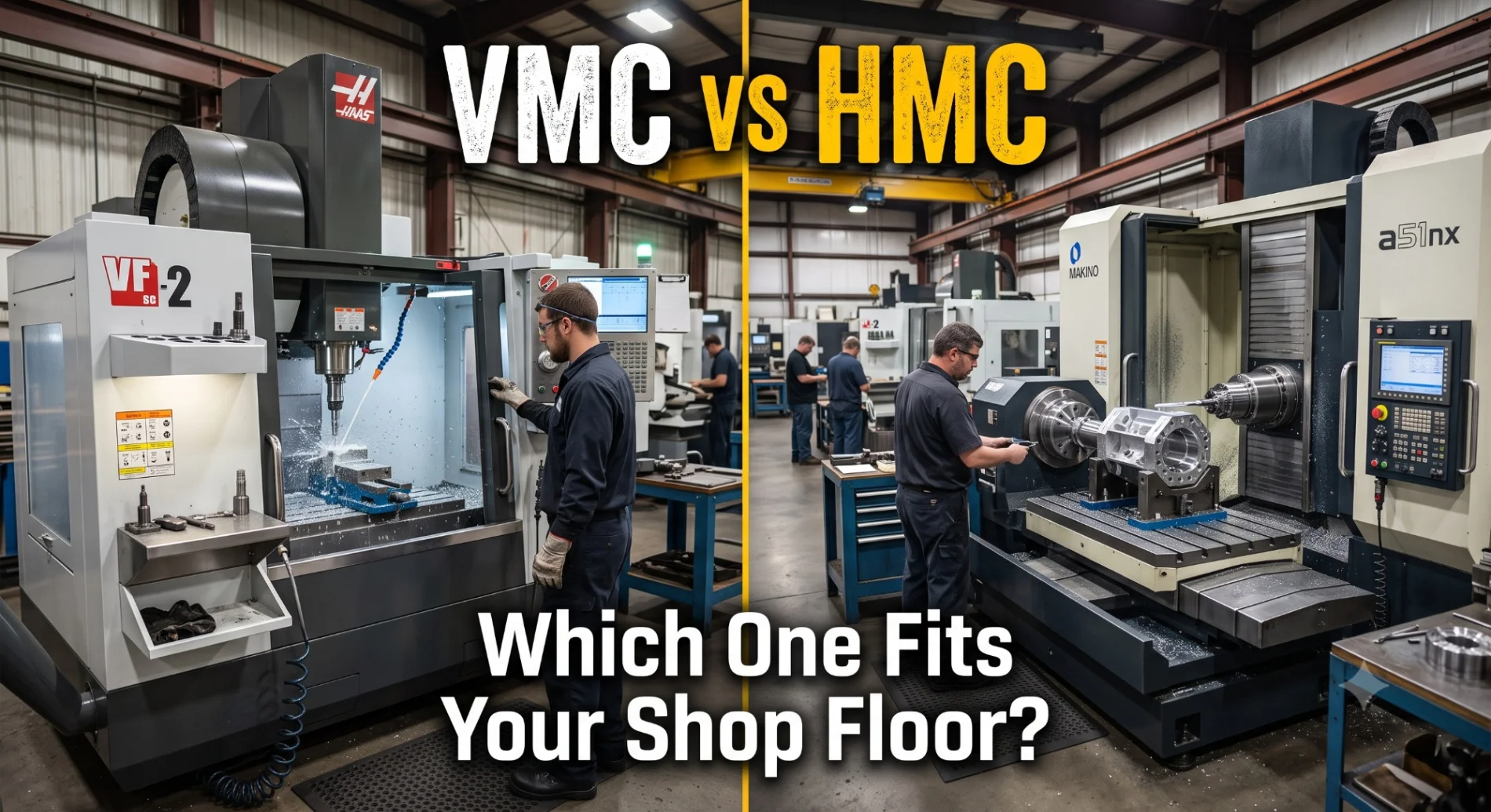
Ask ten job shops what machine they want next and most will say "a machining center." Ask which kind, and the answers split. Vertical machining centers (VMC) and horizontal machining centers (HMC) both mill, drill, tap and bore — but they are built around different assumptions about how work arrives on your floor and how it leaves. Buy the wrong one and you end up with a capable machine that fights your production pattern every shift.
Here is a practical way to think about the difference before you commit.
What a VMC Is Good At
On a vertical machining center the spindle points down. The tool comes at the workpiece from above, the operator loads from the front, and everything about the setup is visible at eye level. That single design choice explains most of the VMC's character.
VMCs suit prismatic parts — plates, housings, brackets, dies, mould inserts, fixture bodies — where most of the cutting happens on one face. Loading is straightforward: clamp in a vice or on the table, touch off, run. Setups are easy to teach, easy to check, and easy to correct when a tolerance drifts.
A VMC also takes less floor space than a comparable horizontal, needs a simpler foundation, and is generally the less complex machine to own and maintain. Spare parts are widely available and most experienced operators in India have run one. For shops doing low to medium volume, varied job work, tooling and die work, or first-article and prototype runs, a VMC is usually the machine that earns its keep.
The trade-off is chips and faces. Chips tend to settle in the pocket around the part rather than fall away, and machining a second or third face means unclamping, re-fixturing and re-indicating — which costs time and stacks up positional error.
What an HMC Is Good At
On a horizontal machining center the spindle points sideways, cutting into the side of the workpiece. Chips fall clear of the cut by gravity, which means better tool life, less heat soaking into the part, and far less time spent clearing swarf.
The bigger difference is the pallet. Most HMCs come with a rotary table or indexer and a pallet changer — commonly two pallets, sometimes a larger pallet pool. The operator loads and unloads one pallet while the machine cuts on the other. With an optional rotary axis, the machine can index the part and cut three or four faces in a single setup, holding tighter relationships between features because the part never leaves the fixture.
That combination — chip evacuation, pallet changing, multi-face machining — is what makes an HMC a production machine. Spindle utilisation goes up because loading time is hidden behind cutting time. Cast housings, pump and valve bodies, gearbox cases, hydraulic blocks and similar multi-face components are the classic HMC parts.
The cost of that capability is complexity. HMCs occupy more floor space, need a more serious foundation, use more sophisticated fixturing (tombstones and angle plates rather than a simple vice), demand more from the CAM programmer, and involve more subsystems — pallet changer, rotary drive, chip conveyor — to keep in good health.
Side by Side
Floor space. VMC has a compact footprint and front access. HMC needs room for the machine, the pallet station, the load area and the chip conveyor.
Typical batch sizes. VMC works well for ones, twos and short runs where changeovers are frequent. HMC pays back when you have repeat batches large enough to justify building and proving dedicated fixtures.
Tooling and setup time. VMC setups are quick and simple but repeat for every face. HMC setups take longer to build initially, then run for hundreds of parts with no re-fixturing.
Unattended running. VMC is largely operator-attended, one part at a time. HMC with a pallet changer is built for long, lightly attended cycles — a genuine path to running through breaks or into a second shift.
Maintenance complexity. VMC is simpler and more forgiving. HMC has more moving subsystems and benefits from a disciplined preventive maintenance routine and an operator who understands it.
A Short Decision Framework
Work through these honestly before you shortlist anything:
What does the part look like? Mostly one-face prismatic work points to a VMC. Multiple faces needing tight relationship to each other points to an HMC.
How many do you make, and how often do they repeat? Occasional and varied favours the VMC. Repeat batches with a forecast behind them favour the HMC.
How many setups does the part need today? If you are re-clamping three times to finish one component and losing accuracy each time, an HMC is solving a real problem — not just adding capacity.
How much floor space and foundation can you actually give it? Measure honestly, including load area and chip evacuation, not just the machine envelope.
Who will run it? An HMC rewards skilled programming and fixturing. If your team is still building depth, a VMC gets you productive faster while you develop that skill.
What is your real bottleneck? If it is spindle time, an HMC helps. If it is setup variety and quick turnaround, another VMC may serve better.
Where Machine City Fits In
We stock both categories of used machining centers — vertical and horizontal — across a range of sizes, spindle configurations and control systems. Every machine that comes through us is physically inspected and documented, so you know its condition, hours and what has been attended to before you decide anything.
If you are still weighing the two, tell us what you are making, in what volume and how many setups it takes today. That conversation is usually more useful than a spec sheet comparison. Reach out via WhatsApp or send an enquiry through the site, and we will point you towards what actually fits your floor — including telling you when the machine you asked about is not the one you need.
Anirudh Singla· Managing Director
Managing Director at Machine City. 16 years of experience in used CNC and industrial machinery trading.