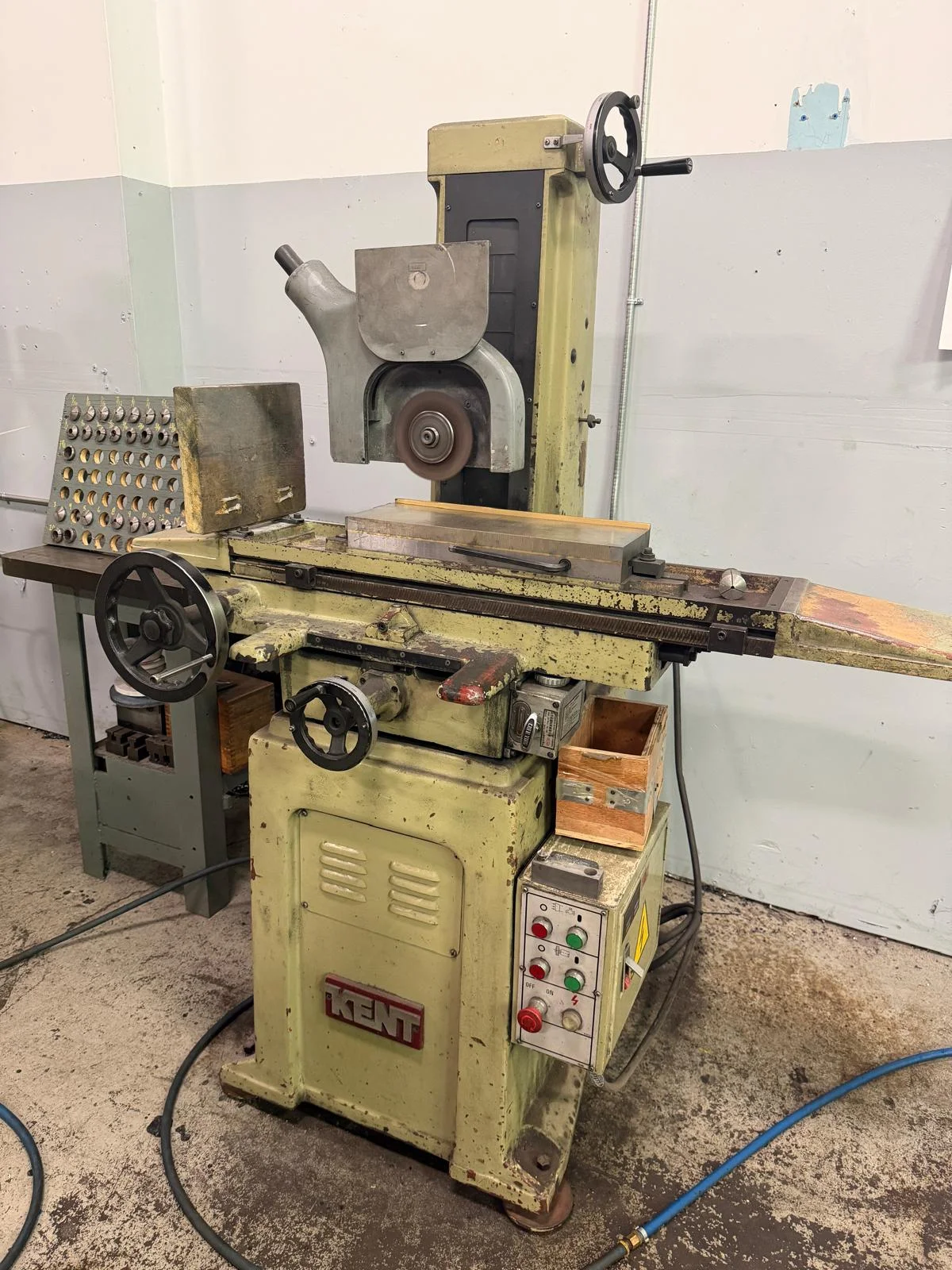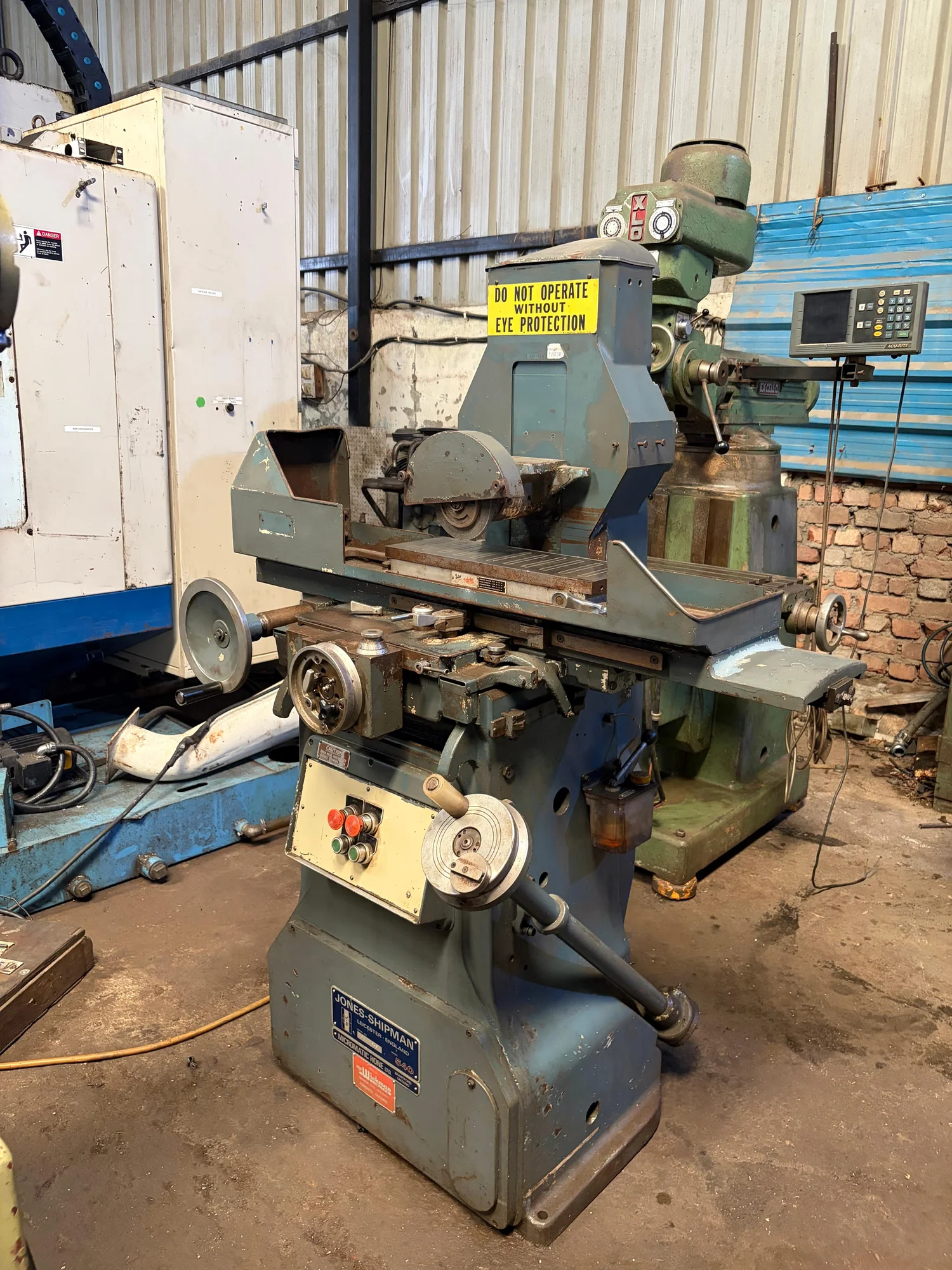
Used
Surface Grinder
Jones-Shipman
540
Travel (mm)
X470
Y170
Z200

Grinding Machinery · Machine City · Mohali
Browse used surface grinders — table up to 1000×300 mm, hydraulic & manual traverse, DRO. Indian & imported. Precision surface finishing. Pan-India.
A surface grinding machine uses a rotating abrasive wheel to produce flat, high-precision surfaces on metal workpieces. Surface grinding is the final-stage precision operation in toolmaking, die-mold, and tight-tolerance part production — it achieves surface finishes of Ra 0.4–1.6 µm and dimensional accuracy to within microns, far beyond what milling or turning can achieve. The workpiece is typically held on a magnetic chuck (electromagnetic or permanent magnet) and traversed under the spinning wheel.
The key specifications on a surface grinder are table length and breadth (which directly determine the maximum workpiece size or the maximum number of smaller parts in a batch), travel X (table longitudinal), travel Y (cross), and travel Z (vertical, which determines how deep a total grind can be taken across multiple passes). Grinding wheel size — diameter, width, and (optionally) bore ID — affects surface coverage and material removal rate. Axis control type matters: hydraulic X-axis traverse provides smooth, consistent table motion for fine finishes; motorized Y-axis with fine graduation allows precise cross-feed increments; and a manual or motorized Z-axis controls downfeed per pass. A DRO is essential for maintaining dimensional accuracy across a grinding session.
Machine City stocks surface grinders from Chevalier, Birmingham, and Japanese brands (Mitsui Seiki, Okamoto, Supertec) as well as Indian-made and Eastern European machines. A well-maintained used surface grinder at 30–50% of new cost is an excellent investment for any toolroom or precision parts finishing operation.
Why Choose Us
Since 2009, over 2,500 machines traded. Every transaction built on the same standard of straight dealing.
Machines sourced from Canada, USA, and Singapore — not reshuffled domestic inventory. Fresh-condition equipment at honest prices.
We coordinate logistics from our Mohali yard. Our transport network reaches buyers across every major industrial city in India.
Live Listings
Buyer’s Guide
Confirm table length and breadth accommodate your largest single workpiece or batch layout. Remember that the magnetic chuck or fixture takes space at the edges.
Inspect the installed wheel for cracks (ring test), trueness, and surface dress condition. Confirm the wheel size (diameter × width × bore ID) matches your wheel specification. A cracked wheel is a safety hazard and must be replaced.
The wheel spindle bearings are the most critical component. Run the spindle to full speed and feel for vibration at the wheel guard. Any spindle vibration translates directly to surface waviness on the ground part.
On hydraulic table grinders, the traverse should be smooth and consistent at all stroke lengths and speeds. Jerky table motion or speed variation under the wheel indicates hydraulic seal wear or valve issues.
Verify the Y-axis handwheel graduation is readable and the cross-feed mechanism engages precisely. Automated cross-feed should step consistently — any skip or over-feed produces unground stripes on the part.
FAQ
Tell us your requirement — capacity, controller preference, budget — and we will match you to available stock or alert you when the right machine comes in. We respond personally to every enquiry.
← Back to all Grinding MachineryReal photographs, accurate condition descriptions, and known issues disclosed upfront. No inflated specifications.
Every enquiry gets a direct response from our team — no automated replies, no call queues. WhatsApp or call; we answer.
For machines in our Mohali yard, arrange a visit before committing. See the machine under power, ask every question.
The magnetic chuck surface must be flat to within 0.005 mm for precision grinding. If the chuck has been re-ground, it should have a measured flatness certificate. A cupped or twisted chuck produces ground parts with the same defect.
A DRO on X, Y, and Z axes eliminates dial misreading errors. Verify all axes read consistently and that the encoders respond to fine table movements (1 µm increment is desirable for Z).